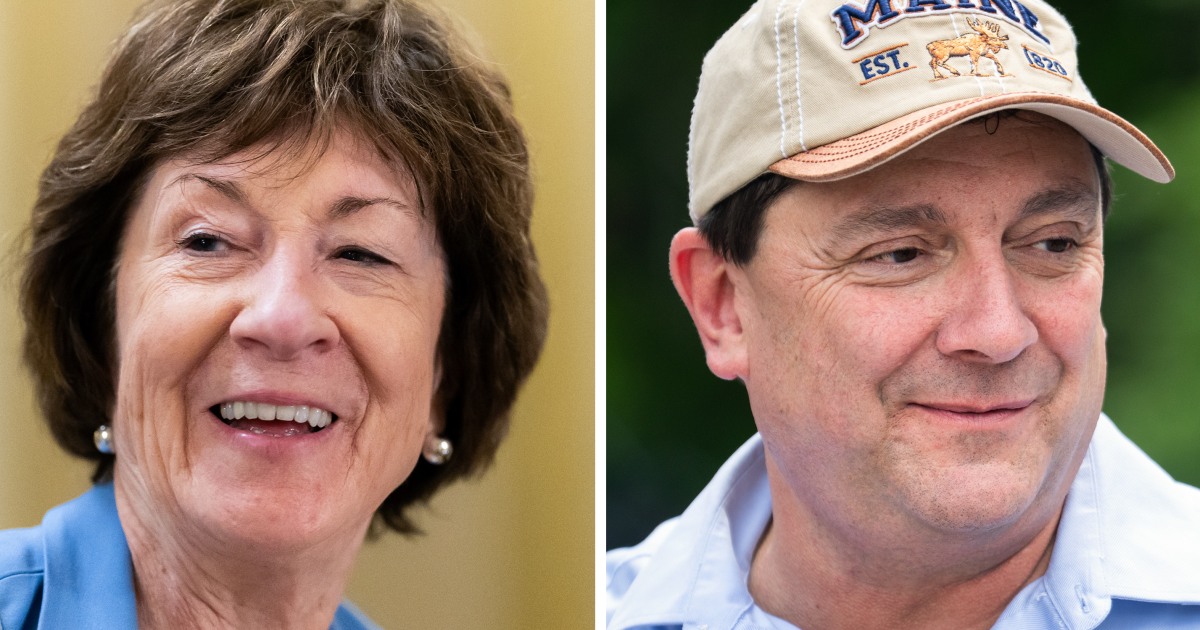
Republican U.S. Sen. Susan Collins and Democratic challenger Troy Jackson debated for the first time Tuesday night on WGME-TV in Maine, trading sharp attacks over their contrasting records and positions on President Donald Trump in one of the nation's most closely watched Senate races.
Jackson, a former state lawmaker and logger, set the tone early by linking Collins to Trump, invoking the president's name at least 20 times during the one-hour debate. He opened with the statement: "It matters who you stand with. I don't owe Donald Trump and the billionaires anything. I don't fight for billionaires like she does." Jackson repeatedly cited a claim that Collins votes in alignment with Trump 96 percent of the time, though Collins questioned the methodology of the study he referenced.
Collins countered by emphasizing instances when she has opposed the Trump administration and highlighted her status as chair of the Senate Appropriations Committee, a position that has allowed her to secure federal funding for Maine. She cited $1.5 billion in federal dollars brought to the state over the past five years for 672 projects, ranging across the state "from Madawaksa to Kittery, from Eastport to Rumford." "Leadership matters in Washington," she said, arguing that her seniority and relationships benefit Maine's taxpayers.
A central flash point was Collins' 2018 vote to confirm Supreme Court Justice Brett Kavanaugh, a Trump nominee who later joined the majority in overturning Roe v. Wade and eliminating the federal constitutional right to abortion. Tuesday's debate coincided with the anniversary of Kavanaugh's confirmation vote. Jackson asked directly: "Would you trust her to pick the next Supreme Court justice?" Collins responded by noting she judges all nominees on qualifications and highlighted her support for liberal justices nominated by Democrats, including Sonia Sotomayor, Elena Kagan, and Ketanji Brown Jackson. Collins also pointed out that she has "always been pro-choice," while Jackson held more conservative abortion positions earlier in his career, a barb Jackson did not directly address in the moment, though he noted in his closing statement that he had pushed for progressive abortion policies in the Maine Legislature.
The candidates also disagreed on Collins' role in advancing President Trump's tax and spending bill, formally called the One Big Beautiful Bill Act. Jackson criticized Collins for voting to advance the bill procedurally, despite her opposition to its final passage and its roughly $1 trillion in Medicaid and food stamp cuts. "Senator Collins is like an arsonist who helped set the fire, and then she wants credit for bringing a cup of water to put it out," Jackson said. Collins countered that she voted against the bill at final passage and has "never voted" to cut Medicaid, and that her procedural vote allowed her to secure a $50 billion fund for rural hospitals.
On the question of Trump's potential campaign visit to Maine, Collins dodged direct answers twice before remarking, "I'm not exactly his favorite senator" and "I would say that he's not coming to Maine." Despite this strained relationship, Trump has endorsed Collins for re-election, and Vice President JD Vance has campaigned on her behalf in the state. Trump has previously said Collins is "not my favorite person."
The Maine Senate race carries significant weight for national politics. Maine is central to Democrats' path to winning Senate control, as the state leans Democratic—it has not voted for a Republican presidential candidate statewide since the 1980s and Trump lost the state in 2024. Collins, seeking a sixth term, is the only Republican senator representing a state Trump lost in 2024. Most polls show the race within the margin of error, and both national parties are spending tens of millions of dollars on the contest. A Collins victory would narrow Democrats' path to the Senate majority.


