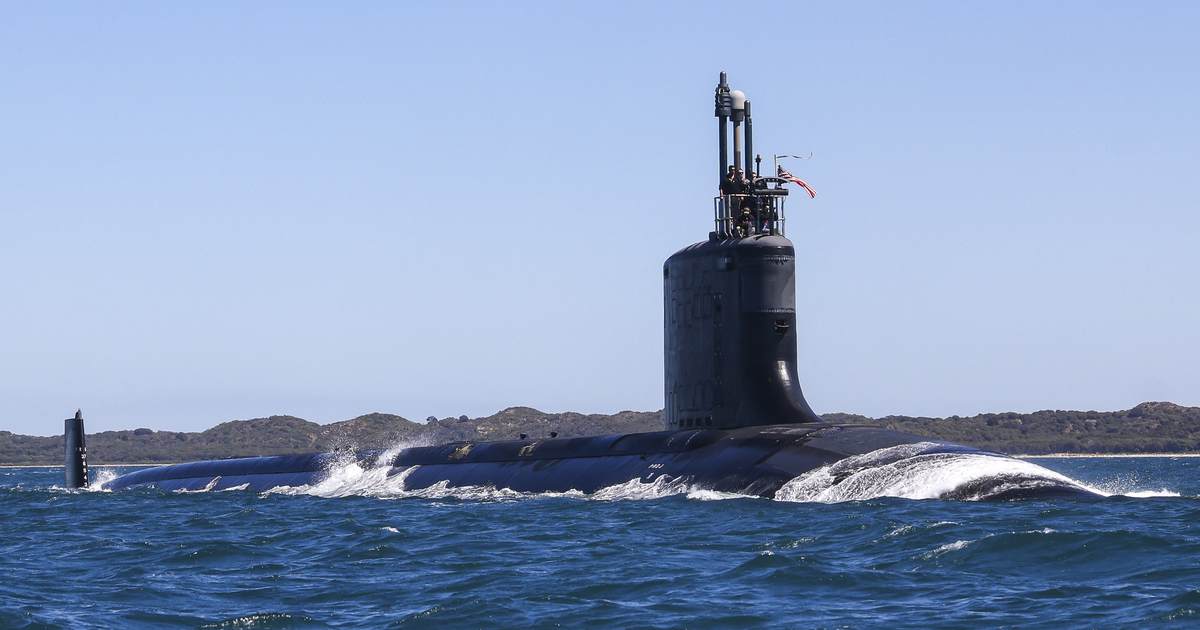
Anduril Industries won a $2.9 billion contract from the U.S. Navy on Tuesday, October 6, to manufacture critical components and large assemblies for Virginia-class attack submarines. The company will pair the contract award with $3.7 billion of its own investment to build a new 2 million-square-foot shipyard facility at Sparrows Point in Baltimore County, Maryland, bringing the total project investment to $6.6 billion.
The facility, known as Arsenal-2, is expected to begin operations in 2030 and will manufacture components including torpedo tubes for delivery to General Dynamics Electric Boat in Connecticut and Huntington Ingalls Industries' Newport News Shipbuilding in Virginia, the two prime contractors for the Navy's submarine programs. Some manufacturing will also occur at a 160,000-square-foot facility in Orange County, California, beginning before the Maryland yard opens. According to a senior Trump administration official, the Baltimore facility could add approximately 9 million production labor hours annually, representing roughly a 15 percent increase in capacity for the Virginia-class program.
The project is expected to create more than 3,100 direct jobs and support more than 11,000 additional jobs, according to Anduril and Maryland officials. The facility will be built on the site of a former Bethlehem Steel plant and will include high-bay assembly halls, fabrication areas, reconfigurable production lines, and a 1,200-foot graving dock with road, rail, and marine connections for moving large submarine assemblies. President Trump announced the investment at an event at Tradepoint Atlantic near Baltimore, stating that "American taxpayers will receive a 40 percent stake in the new shipyard" through a new Anduril subsidiary created to operate the facility, though Anduril clarified the government is not taking an equity stake in the company itself.
The contract award comes days after the Department of Defense appointed Anduril co-founder Palmer Luckey to Project Meridian, a Pentagon initiative to identify and develop future military capabilities. The appointment, alongside participants including former House Speaker Newt Gingrich and SpaceX CEO Elon Musk, raised questions about conflicts of interest given that Anduril actively pursues government contracts. Department of Defense Chief Technology Officer Emil Michael defended the arrangement, telling CNBC that the mix of academics, former military, and industry leaders in the project represents "exactly the right kind of mix that you want" to prepare for future conflicts.
The move reflects a broader strategy by the Navy to increase Virginia-class submarine production by distributing work across multiple suppliers in the industrial base. The Navy currently produces roughly 1.1 to 1.4 submarines per year despite Congressional funding typically supporting two annually. Vice Admiral Robert Gaucher, who oversees Navy submarine construction, said during Tuesday's announcement that the nation has "lost industrial capacity" and that Arsenal-2 represents an effort to "rebuild it." The Navy aims to eventually reach a production rate of approximately 2.33 submarines annually to meet U.S. fleet requirements and commitments to Australia under the AUKUS submarine agreement.
Anduril plans to operate the shipyard using ArsenalOS, its industrial software platform, to manage fabrication workflows, material movements, inspections, and other production processes. According to the company, the platform will provide digital work instructions, embedded quality controls, and automation while supporting skilled trades workers. Anduril President and Chief Strategy Officer Chris Brose said the software approach is designed to make production requirements more visible and help new workers train faster while maintaining quality standards.
The contract award follows a series of major defense contracts for Anduril. On October 5, the company announced it won a $1.8 billion Army contract to develop next-generation command and control architecture. The submarine component contract represents Anduril's expansion into traditional naval shipbuilding, a significant departure from its focus on autonomous aircraft, weapons, and unmanned maritime systems. Brose stated that Anduril's goal is to become "a critical and hopefully over time much larger and growing part of the supply chain" for the Navy's lead shipbuilders.