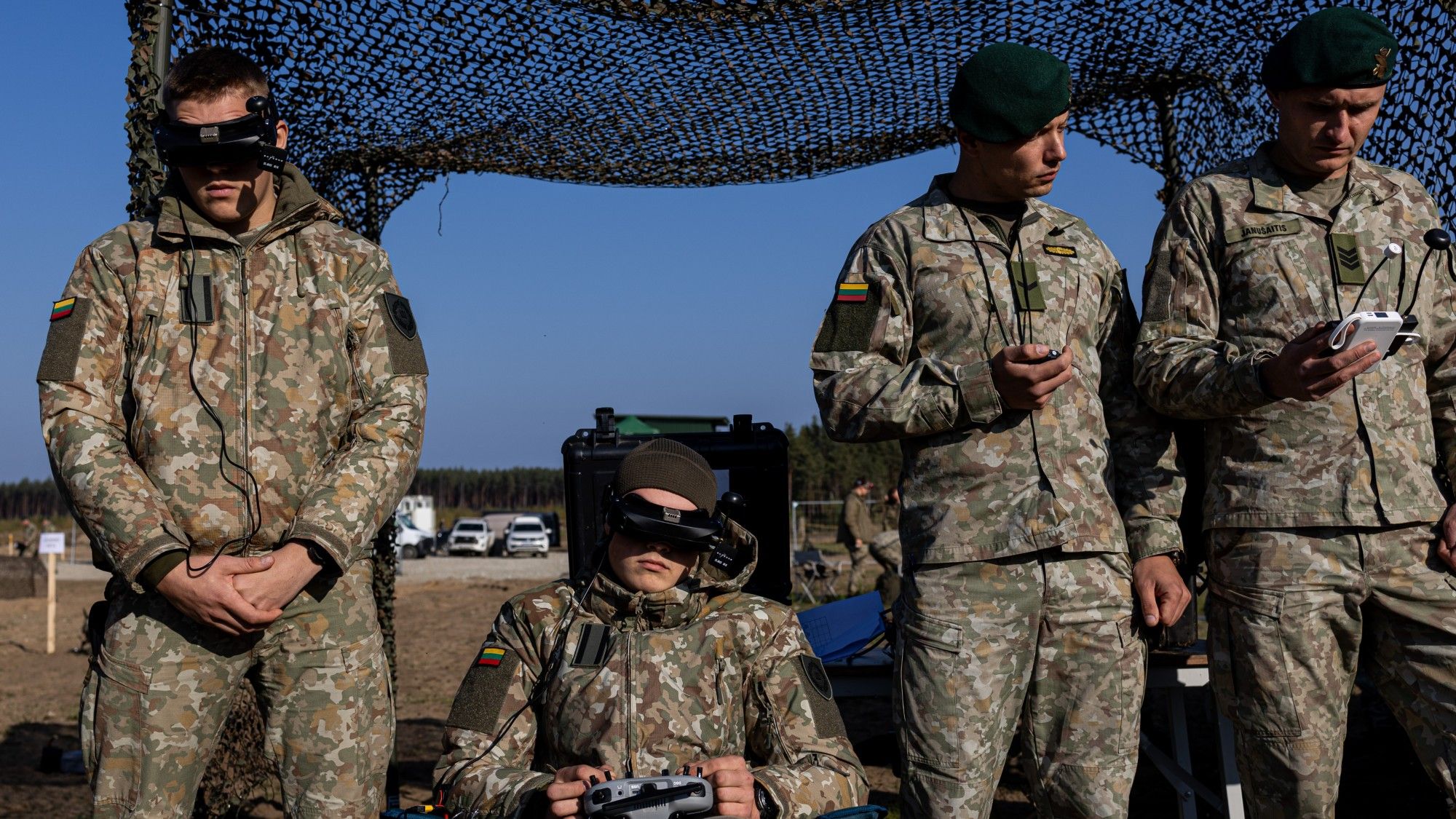
Lithuania's Prime Minister Mindaugas Sinkevičius has called for a firm NATO plan to respond to Russian hybrid attacks, warning that Moscow was demonstrating a "willingness to test" NATO's defenses, according to reporting from Politico cited in available accounts. The demand follows a series of drone incursions into Lithuanian airspace that have prompted emergency responses including airport closures and civilian evacuations.
The most recent incident involved the forced closure of Lithuania's largest airport due to a suspected drone believed to have crossed from Belarus into Lithuanian territory. In September, Lithuania shot down a military drone over its airspace for the first time, marking an escalation of security incidents in the Baltic region. Similar drone violations have also been reported in neighboring Latvia and Estonia. In May, residents in Vilnius were forced to take shelter across the capital after a drone alert was triggered, briefly grounding flights and rail travel.
Military drone incursions have become increasingly common across Europe since Russia's full-scale invasion of Ukraine began, with the incidents serving as a reminder of Lithuania's geographic vulnerability. Lithuania shares a large portion of its southern and eastern border with Belarus, which analysts describe as a key Russian ally. The country is simultaneously a staunch supporter of Ukraine, positioning it in a delicate strategic position between Western allies and Russian interests.
In response to mounting security concerns, Lithuania has undertaken significant defensive measures. The country has allocated nearly €5 billion to defense spending this year, representing 5.38% of its GDP—a figure that substantially exceeds defense spending in other NATO members, including the United Kingdom at 2.6% of GDP. Additionally, Lithuania has been conducting military drills and rehearsing wartime evacuation plans, indicating preparations for potential escalation.
Security analysts have long identified the Suwalki Gap as a critical vulnerability in NATO's eastern defenses. This 40-mile corridor of land runs along the Polish-Lithuanian border and connects the Russian exclave of Kaliningrad to Belarus. The gap has been characterized as NATO's "Achilles heel," as military strategists assess that Russia could potentially seize it through a coordinated pincer assault from Kaliningrad in the northwest and Belarus in the southeast. Such a maneuver would create a land bridge isolating the Baltic states—Lithuania, Latvia, and Estonia, all NATO members—from the European Union. U.S. General Ben Hodges has described the gap as "one of the most volatile points on the world map."
Sinkevičius has warned that a Russian victory in Ukraine would likely prompt Moscow to seek "other directions" for military expansion, potentially escalating threats to the Baltic region. Local residents have expressed fears about the prospect of conflict, with concerns ranging from potential bombardment to invasion scenarios.
The situation reflects broader European security concerns stemming from Russia's actions in Ukraine. NATO's eastern flank, particularly in the Baltic region, has become an area of heightened military activity and diplomatic focus as alliance members assess strategies to deter potential Russian aggression.