One year after a US-brokered ceasefire took effect on October 10, 2025, humanitarian organizations, medical professionals, and residents of Gaza say the agreement has failed to bring the promised peace, with Israeli military operations continuing and reconstruction efforts remaining stalled.
Israeli forces have continued striking Gaza on a near-daily basis throughout the past year, according to multiple aid organizations and news reports. Gaza's Health Ministry reports that Israeli strikes have killed approximately 1,450 Palestinians since the ceasefire began, while Human Rights Watch cited at least 1,400 Palestinian deaths and 4,881 wounded as of October 10, 2026. These figures bring the total death toll since the October 7, 2023 Hamas attack on Israel to over 74,000, including more than 21,000 children.
Israeli forces now control approximately 70 percent of Gaza, according to official accounts cited in reports, substantially exceeding the 53 percent of territory they were permitted to occupy under the ceasefire agreement. As Israeli officials describe the line of military presence as Israel's "new border," Palestinians continue to be displaced from areas where Israeli forces operate. Meanwhile, the ceasefire has achieved one stated objective: no rocket attacks have been launched from Gaza into Israel over the past year, and Hamas's missile inventory was depleted during prior bombardment.
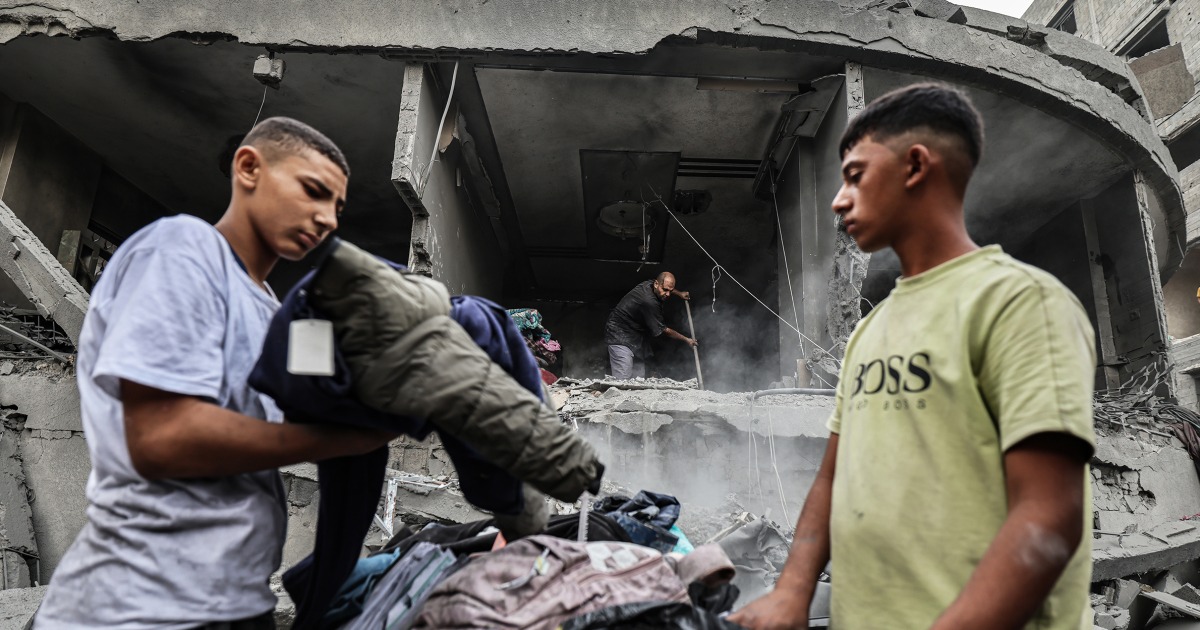
The humanitarian situation remains dire despite the reduced intensity of Israeli attacks. According to Human Rights Watch, 94 percent of Gaza's population lacks adequate shelter. The UN reports that 82 percent of all standing structures in Gaza are either damaged or destroyed as of mid-2026, forcing more than two million residents—nearly the entire population—to live in tents or makeshift shelters. A damaged building housing about 100 people collapsed in September 2026, killing 21 people, including 12 children. Disease outbreaks have increased due to overcrowded conditions, poor waste management, sewage overflow, and rodent infestation. The Integrated Phase Classification reported in July that 67 percent of Gaza's population—over 1.4 million people—are expected to face crisis or worse levels of acute food insecurity in the second half of 2026.
Promised political and institutional transitions have not proceeded as agreed. Technocrat Ali Shaath was appointed head of a new National Committee for the Administration of Gaza (NCAG) under the second phase of the ceasefire agreement, and Hamas announced in July that it was disbanding its governing body to hand over administration to the US-backed committee. However, Hamas effectively remains in charge of security in Gaza, and Shaath has taken a low profile. Hamas did elect a new leader, Khalil al-Hayya, in July and announced it would give up its weapons—a move the Trump administration hailed as a breakthrough—but the group has not followed through with disarmament, and Israel has refused to begin withdrawing forces pending verifiable decommissioning of weapons.
Reconstruction efforts have not begun despite being central to the ceasefire agreement. The Board of Peace, established by President Trump and authorized under UN Security Council Resolution 2803, proposed a $2.45 billion Gaza recovery plan in September 2026. However, according to reports, no money is known to have reached Gaza for reconstruction, and recovery efforts have not started. The UN and European Union estimate that Gaza's recovery and reconstruction needs total $71.4 billion over the next decade. Israel continues to control all entry points into Gaza and restricts the amount of humanitarian aid allowed in, keeping prices of basic goods too high for ordinary residents.
Residents and medical professionals express deep skepticism about the ceasefire's impact on their lives. Fatima Awkal, a displaced woman in Gaza City, told the Agence France-Presse news agency: "Nothing has changed for the better; everything has gotten worse, they lie to us, it is all lies. Martyrs are still falling, people are still being injured, the shelling continues, and we cannot even find a moment's peace from the constant buzzing of the drones overhead." Ahmed Shawan, a doctor at a hospital in Khan Yunis, stated: "It has been a full year since the ceasefire was declared, yet it exists only on paper." Ahmed Jonaid, a 51-year-old displaced Palestinian, said he had hoped to return home after the ceasefire but instead remains in refugee camps. "We thought we would experience some happiness and return to our homes. Instead, we see ourselves suffering in refugee camps, sleeping on makeshift mats," he said.
Meanwhile, large pro-Palestinian marches have taken place in Western cities marking the third anniversary of the October 7 attack. Thousands of people marched in London, Berlin, and Dublin, with some placards calling for an end to Israeli strikes on Gaza. Aimee Shalan, director of the Palestine Solidarity Campaign, told AFP: "We are here today to mark three years of the ongoing genocide in Gaza."