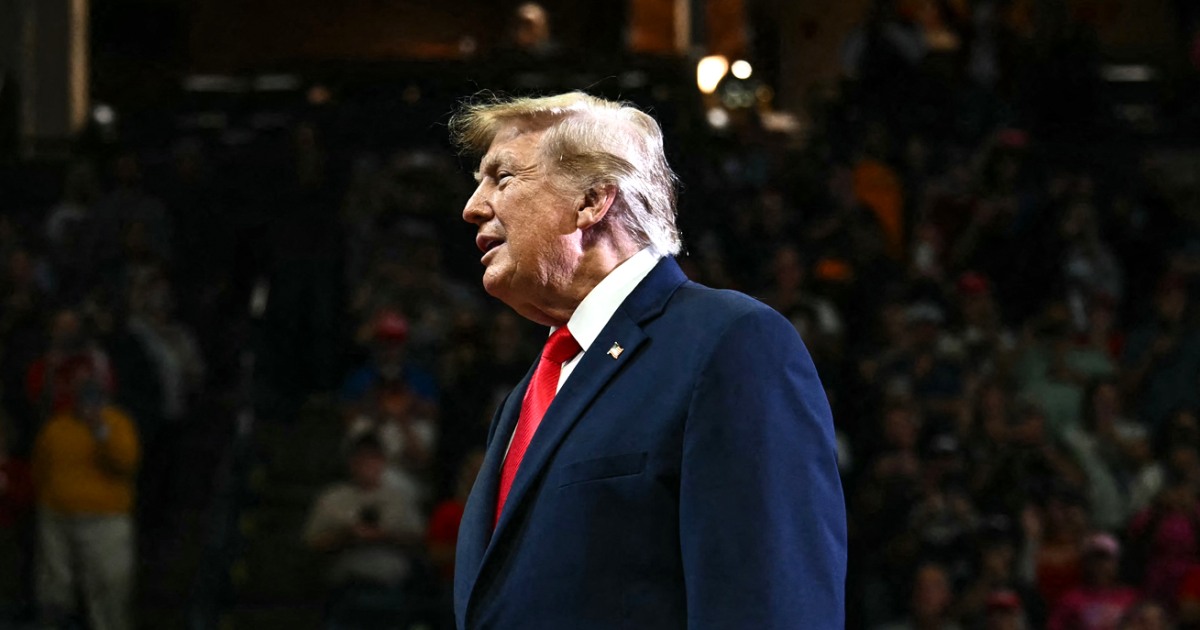
President Donald Trump launched attacks on Democratic Rep. Ilhan Omar of Minnesota and Abdul El-Sayed, the Democratic Senate nominee in Michigan, at a campaign rally held Monday evening at Youngstown's Covelli Centre in Ohio.
During his remarks, Trump criticized Omar, calling her "a disaster" and referencing her Somali background. "She comes in from a country without laws, without police, without military, where all they do is shoot each other, and she comes into our country and she says, 'I have a constitutional right,'" Trump said. He connected his criticism of Omar to what he characterized as gang activity and security concerns in Minnesota, mentioning Somali gangs and referencing an alleged shooting plot at the Mall of America that the FBI had thwarted. The plot was allegedly carried out by an American-born citizen of Somali descent, according to reporting by the Associated Press. These remarks prompted the first wave of "deport" chants from the audience.
Omar, who was born in Somalia and immigrated to the United States as a child, responded to the attacks on social media. "For 10 years, Trump has targeted me with baseless lies and smear campaigns," she wrote on X (formerly Twitter). "This is just the latest escalation in his campaign of political intimidation." The rally took place hours after federal agents from Homeland Security Investigations executed a search warrant at Omar's Washington residence. A Justice Department spokesperson confirmed the search was "part of an ongoing federal criminal investigation" but did not specify whether it was related to Omar or provide additional details. When speaking to reporters Monday afternoon, Trump said he had "nothing to do" with the search.
Trump then turned his focus to El-Sayed, calling him a "jihadist" and stating: "These people are crazy. You look at the guy running in Michigan. He's a jihadist." Trump praised El-Sayed's Republican opponent, former Rep. Mike Rogers, and added: "Somalia bandits, Third World gangsters, jihadist sympathizers do not belong in Ohio. They don't belong in America. Better get them the hell out of here." These comments again prompted audience chants of "deport." El-Sayed's campaign did not immediately respond to requests for comment Monday night.
El-Sayed, who is Muslim and was born in Michigan to Egyptian immigrants, has previously addressed attacks centered on his name and faith. Last week, after Trump referred to him by his middle name, Mohamed, on social media, El-Sayed condemned the tactic. "They point to my name and they point to my faith, trying to distract us from the challenges that we have," El-Sayed told supporters at a Thursday event in Grand Rapids, Michigan. "My name did not raise your gas prices. My faith is not the reason you can't afford your groceries."
The rally was Trump's second visit to Ohio in less than ten days. He was in the Mahoning Valley, a region that has shifted from reliably Democratic to increasingly Republican since Trump's rise in politics, to campaign for Sen. Jon Husted and Vivek Ramaswamy, the state's Republican nominee for governor. Trump's rhetoric on immigration and national security has continued to escalate following El-Sayed's Michigan Democratic primary victory. Days after that primary win, Trump warned that the U.S. could become a "jihadist-run country." Additionally, Sen. John Kennedy, R-La., accused El-Sayed of sympathizing with Osama bin Laden while campaigning with Rogers in Michigan last week.
According to spending data tracked by AdImpact, Republicans had outspent Democrats by $78 million to $63 million in the Michigan Senate race as of October 10, with approximately $40 million in Republican spending directed toward negative advertisements. Those ads describe El-Sayed as "dangerously radical" and "too extreme," referencing his past calls to defund the police and relax immigration enforcement.