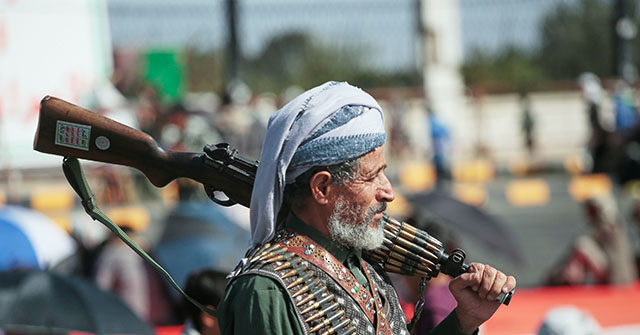
Houthi militants launched a deadly ballistic missile attack Thursday on the Al-Maashiq presidential palace in Aden, the interim capital of Yemen's internationally recognized government, killing at least five people and injuring 16 others, according to Yemeni government officials.
Yemeni Information Minister Moammar al-Eryani said five missiles struck the palace complex, which serves as the headquarters of the Presidential Leadership Council (PLC). Health Minister Qasim Buhaibeh characterized those killed as "guards and civilian employees" of the facility, while a government statement specified that two of the fatalities were bodyguards of Prime Minister Shaya al-Zindani. Eryani said the prime minister and cabinet members were safe, though sources disagreed on whether Zindani was present during the attack—one government minister told Agence France-Presse that Zindani was at the palace but "was not harmed in any way," while another official statement did not specify his location. An AFP journalist reported seeing smoke rise from the complex, and residents of the southern city heard explosions during the strike, the first major attack on the complex since Yemen's civil war reignited in July.
Houthi military spokesman Yahya Saree said the attack targeted what he described as a "military operations headquarters" led by Saudi officers at the palace, as well as weapons depots, characterizing the strike as part of the group's declared policy of "targeting Saudi military build-ups wherever they are." A Yemeni government minister told AFP that the attack hit command centers for both Yemeni government forces and Saudi-led coalition forces, with casualties on both sides, though no specific breakdown was provided. Prime Minister al-Zindani denounced the attack on social media as a "cowardly" act and a "continuation of its criminal pattern of striking civilian sites and civilians." The Yemeni government called it a "terrorist" attack and said the Houthis also launched "several ballistic missiles" at the city of Marib, a strategic oil-rich area in central Yemen.
The strike represents the latest escalation in Yemen's conflict, which has been intensifying since the collapse of a UN-brokered truce earlier this year. The Houthis, an Iran-backed militant group designated as terrorists by multiple countries, seized the capital Sanaa in 2014, prompting a Saudi-led military intervention in 2015. The Yemeni government has operated from Aden since 2015, though many executive functions are conducted from Riyadh. After years of relative stability under a de facto truce that began in 2022, major fighting reignited in July. In recent weeks, the Houthis have seized significant territory along Yemen's Red Sea coastline, and a government counteroffensive supported by Saudi air power has failed to reverse those gains.
Saudi Arabia blamed Iran for the escalation, with Deputy Minister for Public Diplomacy Dr. Rayed Krimly stating: "We think that the escalation by the Houthis at this latest stage of the conflict is encouraged by Iran." Krimly said Saudi Arabia "continues to arm, train and support the Houthi militia in violation of U.N. security council resolutions" and noted that the Houthis refused an offer to meet in Oman to de-escalate. He indicated that the escalation may affect the 2023 China-brokered rapprochement between Saudi Arabia and Iran. Saudi coalition spokesman Maj. Gen. Turki al-Maliki said the Houthis have launched over 1,000 ballistic missiles and 1,100 drones at Saudi Arabia since March 2016, and called on the group to "immediately cease all terrorist operations targeting civilians and civilian facilities."
The attack followed a strike on Riyadh's international airport on Saturday that killed 13 people and wounded around 300—Saudi Arabia's deadliest attack in more than a decade. Coalition officials said the Houthis have attacked Riyadh's King Khalid International Airport 20 times this month, and have also targeted Abha airport in southwestern Saudi Arabia, killing three people and wounding 28 there. One coalition source told AFP that while the palace compound does contain command centers for both Yemeni and Saudi forces, Zindani was present during the attack but "was not harmed in any way," contradicting earlier statements about his presence and location.
The escalation underscores the fragility of regional stability and the broader Middle East conflict that intensified following U.S.-Israeli strikes on Iran in February. The violence threatens the 2023 China-mediated agreement between Iran and Saudi Arabia, which had represented a rare diplomatic breakthrough in the region. Al Jazeera News described the palace attack as "an indication that the escalation is going to intensify between both sides," with potential for an "all-out civil war" between the Houthi-controlled territories and the internationally recognized government.