Poland's Constitutional Tribunal, the nation's highest court, entered a state of acute crisis on Friday, Oct. 30, after judge Anna Korwin-Piotrowska suspended tribunal president Bogdan Swieczkowski and assumed leadership of the institution. The suspension triggered an extraordinary response: President Karol Nawrocki, who was en route to Senegal for an official visit, ordered his aircraft to turn around and return to Poland. "At such a moment, the President must be in Poland. I'm interrupting my flight to Senegal. I'm returning," Nawrocki wrote on social media platform X.
The suspension occurred against the backdrop of a constitutional standoff that has paralyzed Poland's top court for months. Swieczkowski, a former deputy justice minister appointed by the nationalist Law and Justice party during its 2015-2023 rule, had refused to allow judges nominated by parliament under Tusk's current pro-European government to assume their seats. Nawrocki, aligned with the opposition party, had also refused to formally swear in three of six judges nominated by parliament earlier this year. This mutual obstruction rendered the tribunal effectively unable to function, with competing claims of authority and legitimacy.
The immediate trigger for Friday's action was a formal request from Poland's Justice Minister and Attorney General Waldemar Zurek seeking the removal of Swieczkowski's and his deputy's legal immunity. Korwin-Piotrowska, described as the tribunal's longest-serving judge, invoked that legal change to suspend Swieczkowski and install herself as the court's acting head. However, the tribunal's official social media account immediately rejected the suspension, calling it a "coup d'état" and insisting that Swieczkowski remained in office. The account also noted that Korwin-Piotrowska could not lawfully assume leadership because she had not been formally sworn in by President Nawrocki.
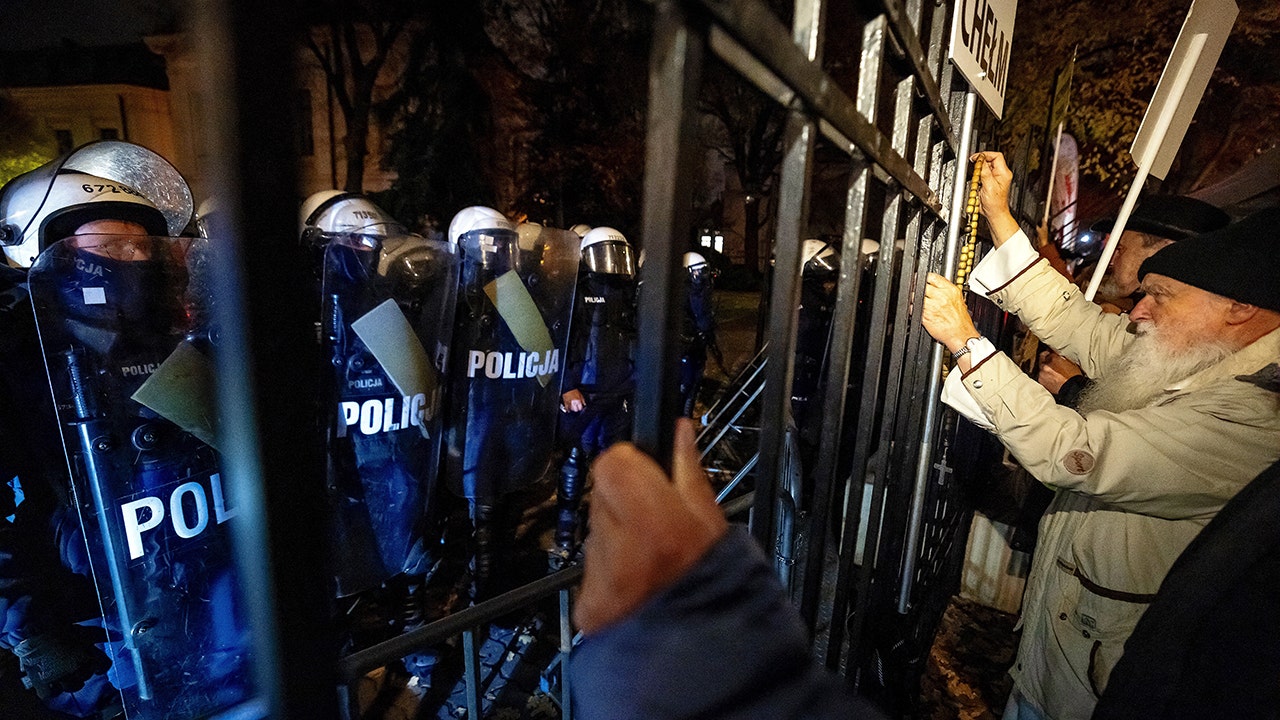
Police deployed to the grounds surrounding the Constitutional Tribunal building in Warsaw following reports of disturbances and dangerous objects being thrown at officers. Hundreds of protesters, predominantly supporters of the opposition Law and Justice party, gathered outside the building. Some demonstrators held placards reading "Tusk — a symbol of anti-Polish sentiment" and "Stop destroying the state," while others prayed with rosaries. Opposition politicians addressed the crowd, accusing Tusk's government of conducting a coup against the court. Retired Justice Minister Zbigniew Ziobro wrote on X: "A coup d'état is underway. If someone were to forcibly break into the Prime Minister's Office and take it over, we would all know what to call it."
Prime Minister Tusk defended the government's actions as essential to the restoration of judicial independence. "Restoring the rule of law is our duty," he wrote on X. "After years of PiS-led lawlessness, this is a difficult process, sometimes painful, and it requires decisive action. There is no other way." The dispute between Tusk's government and Poland's judiciary originates in 2015, when the Law and Justice party began appointing judges to seats already occupied under the previous government, effectively gaining control of the Constitutional Tribunal. The European Union repeatedly raised concerns about the court's independence during that period and imposed financial penalties on Poland for what it characterized as judicial interference. When Tusk returned to power in 2023 after a two-decade absence, he pledged to repair the judiciary and resolve disputes with Brussels.
The confrontation has left Poland's highest court in a state of institutional paralysis. The tribunal's website was inaccessible on Friday evening, and both sides claim authority over the institution. U.S. Ambassador to Poland Tom Rose described the situation as "very serious indeed," stating that the country appeared to be witnessing "an unprecedented confrontation over the government's use of state power and the independence and authority of a constitutional institution." Former Prime Minister Mateusz Morawiecki, leading a coalition positioning itself as an alternative to Tusk ahead of parliamentary elections scheduled for November 2027, condemned the suspension as unlawful but also cautioned that replacing "one disputed set of rules with a more radical one only invites the next government to do the same."
The crisis highlights the depth of Poland's institutional divisions. With the presidency and government controlled by opposing political camps, neither side recognizes the other's judicial appointments, and each accuses the other of undermining constitutional order. The dispute has rendered the Constitutional Tribunal incapable of fulfilling its core function of adjudicating constitutional questions, leaving Poland's highest court paralyzed at a moment of acute political conflict.