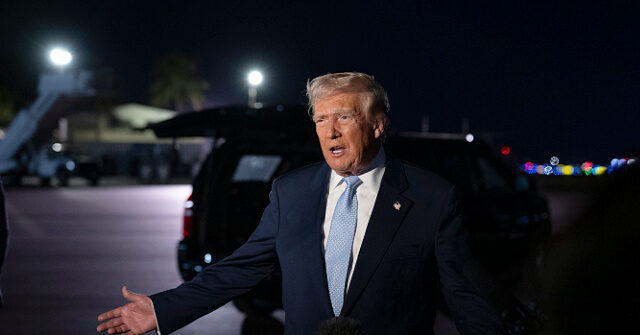
President Donald Trump said Thursday that his administration will soon decide whether to launch another round of major strikes against Iran. Speaking to reporters in the Oval Office at the White House, he said: "I would rather not destroy the rest of the country if possible, but maybe I'll have to. You'll know soon enough."
The comments followed national security meetings at the White House on Wednesday and Thursday, according to senior officials cited by Fox News. Axios, citing two U.S. officials, reported that Thursday's session was Trump's first meeting with his top national security advisers on Iran since the Nov. 3 midterm elections. "Now we will make a decision," Trump said, asking whether the U.S. wants to go further to ensure Iran's nuclear program is dead and "it will never happen again." He added that U.S. forces are "very much locked and loaded."
The deliberations come after Republicans lost heavily in the midterms; Israel National News reported that Democrats won control of both the House and the Senate. Bloomberg reported that Trump said earlier this week he had no immediate plans for new strikes and that the U.S. was "getting everything we want" in the negotiations. Options now reportedly include a renewed large-scale campaign, continued sanctions and the naval blockade, or a deal. Breitbart reported that Vice President JD Vance has emerged as a leading advocate of diplomacy.
On the military side, a U.S. official told reporters that U.S. Central Command is finalising preparations for a possible resumption of major combat operations but has not received a new directive, according to the Times of India. Officials noted that Nov. 9 brings a new moon in the Middle East, with little moonlight. A third carrier group, led by the USS Theodore Roosevelt, is not expected in the region until mid-November, a U.S. official said. Iraqi Prime Minister Ali Faleh Al-Zaidi told Trump by phone that Iraqi territory must not be used to launch attacks on neighbouring countries, his office said.
Diplomacy is also moving. Iranian Foreign Minister Abbas Araghchi held calls with mediators from Qatar, Saudi Arabia, Turkey, the United Arab Emirates, Oman and Egypt, according to Axios. The New York Times reported that Iran is reviewing substantive proposals conveyed by mediators, and Reuters reported that Iran sent a nuclear proposal to the U.S. through Qatar. A Qatari draft would have the U.S. lift its naval blockade and release some frozen funds on day one, with Iran inviting International Atomic Energy Agency inspectors to bombed sites. The Strait of Hormuz would reopen on day two, followed by talks on Iran's highly enriched uranium stockpile, regional sources said.
Iranian officials have set conditions. Mohsen Rezaei, secretary of Iran's Supreme National Security Council, said after meeting Russian President Vladimir Putin that the Strait will not reopen and no negotiations will occur until the U.S. meets seven conditions. Those reportedly include lifting sanctions, releasing frozen assets, compensation for war damage and ending the blockade. Washington has rejected several of them and has insisted Iran's nuclear program be permanently dismantled.
The war began in late February, when the U.S. and Israel attacked Iranian targets, and a truce took hold in early April, Bloomberg reported. Brent crude traded near $101.70 a barrel on Wednesday, up almost 70% this year. Trump has said the conflict is not a war comparable to Russia-Ukraine, citing the lack of deaths in recent months.