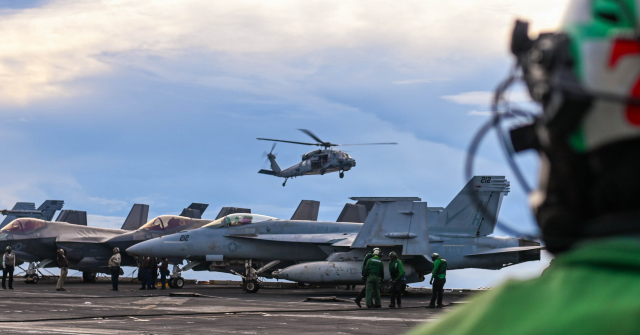
The U.S. military confirmed on Monday, Nov. 16, that the USS Theodore Roosevelt has arrived in the Middle East, joining two other American aircraft carriers in the region as part of an ongoing military buildup amid tensions with Iran. The Roosevelt entered the area of responsibility of U.S. Central Command (CENTCOM) after transiting the Indian Ocean on Sunday, joining the USS George H.W. Bush and USS George Washington, which have been operating in the Arabian Sea since April and August, respectively.
The arrival marks only the second time this year that three American aircraft carriers have operated simultaneously in the Middle East, a concentration last seen in April and not observed since the 2003 invasion of Iraq. According to officials familiar with the deployment, the American military presence in the region now includes approximately 50,000 to 53,000 personnel, along with 13 destroyers, two cruisers, a littoral combat ship, and an additional amphibious force carrying roughly 2,000 Marines that is headed toward the region. The Theodore Roosevelt departed San Diego in September and made stops in Japan and Singapore before reaching the Middle East.
The buildup occurs as President Donald Trump maintains open military options while keeping diplomatic channels uncertain. Trump has stated that the U.S. military is "locked and loaded" and that he would not hesitate to order renewed strikes if necessary, while also declaring the war "militarily is effectively over" and expressing skepticism about the need for a new agreement with Iran. Last week, Trump removed Vice President JD Vance from peace negotiations, stating that Washington no longer needs a deal with Tehran. Iranian officials, however, have indicated a willingness to pursue diplomacy, with Foreign Minister Abbas Araghchi stating on Nov. 16 that Iran remains committed to peaceful solutions.
The deployment reflects ongoing military pressure on Iran, which continues to face a U.S. naval blockade that has effectively cut off its oil exports. According to Treasury Secretary Scott Bessent, Iran's economy could contract by 25 percent between March 2026 and March 2027 under current sanctions and blockade conditions. CENTCOM reported that Gulf partners have shipped more than 1.7 billion barrels of crude oil through the Strait of Hormuz under American protection, with U.S. Air Force F-16 fighter jets patrolling regional waters.
Iran has responded to the military pressure with renewed threats and attacks on American assets. The Iranian Islamic Revolutionary Guard Corps claimed to have launched drone attacks against U.S. radar installations in Bahrain on Friday, Nov. 13, and Sunday, Nov. 15, though CENTCOM stated that U.S. forces intercepted both attacks without casualties or damage. Iranian officials have also threatened preemptive strikes against American forces if they believe an assault is imminent, with Deputy Foreign Minister Kazem Gharibabadi warning of potential Iranian action before another U.S. attack.
Despite extensive earlier strikes by U.S. and Israeli forces, Iran is believed to retain between 1,500 and 2,500 missiles, according to U.S. intelligence assessments cited by the Wall Street Journal, though officials remain uncertain about how many remain operational. Israeli military officials have warned that Tehran is actively pouring resources into rebuilding its missile and drone arsenal despite mounting economic pressure and restrictions on the range of its missiles that Iran claims have been lifted.
The arrival of the Roosevelt comes nearly two weeks after the Nov. 3 midterm elections, which delivered significant losses to Trump's Republican Party driven in part by public opposition to the Iran war and its economic effects. The military deployment also reflects the stalled state of negotiations, with disagreements centered on Iran's nuclear program and the naval blockade. Iran has demanded that the U.S. lift the blockade as a precondition for talks, while Trump has insisted that nuclear concerns must be part of any agreement.
Saudi Crown Prince Mohammed bin Salman and Turkish President Recep Tayyip Erdogan have both urged Trump to avoid renewed strikes, arguing that current American sanctions and the blockade are already placing significant pressure on Tehran without the need for additional military escalation.