Taiwan's deputy foreign minister warned on Saturday that Prime Minister Mark Carney risks exposing Canada to the economic coercion he has cautioned against by deepening trade ties with China. Chen Ming-chi made the remarks in an interview with The Associated Press at the Halifax International Security Forum in Nova Scotia. Asked about Carney's efforts to improve relations with Beijing, Chen said, "We worry. We worry."
Carney has warned that major powers are using economic integration as a weapon, citing U.S. tariffs and China's restrictions on critical minerals. He has urged middle powers to diversify their trade relationships to avoid economic coercion. Chen praised Carney's speech at the World Economic Forum in Davos, Switzerland, but questioned whether Canada should deepen ties with countries that do not share its democratic values. "Who do you want to choose as your partners?" he asked.
Chen pointed to the cases of former Canadian diplomat Michael Kovrig and businessman Michael Spavor, saying, "You have your own history. You have two Michaels." The two men were arrested in 2018 shortly after Canada detained Huawei executive Meng Wanzhou on a U.S. extradition request. Their nearly three-year detention in China prompted accusations of hostage diplomacy. They were released in September 2021, the same day Meng returned to China. Beijing denied their detention was politically motivated.
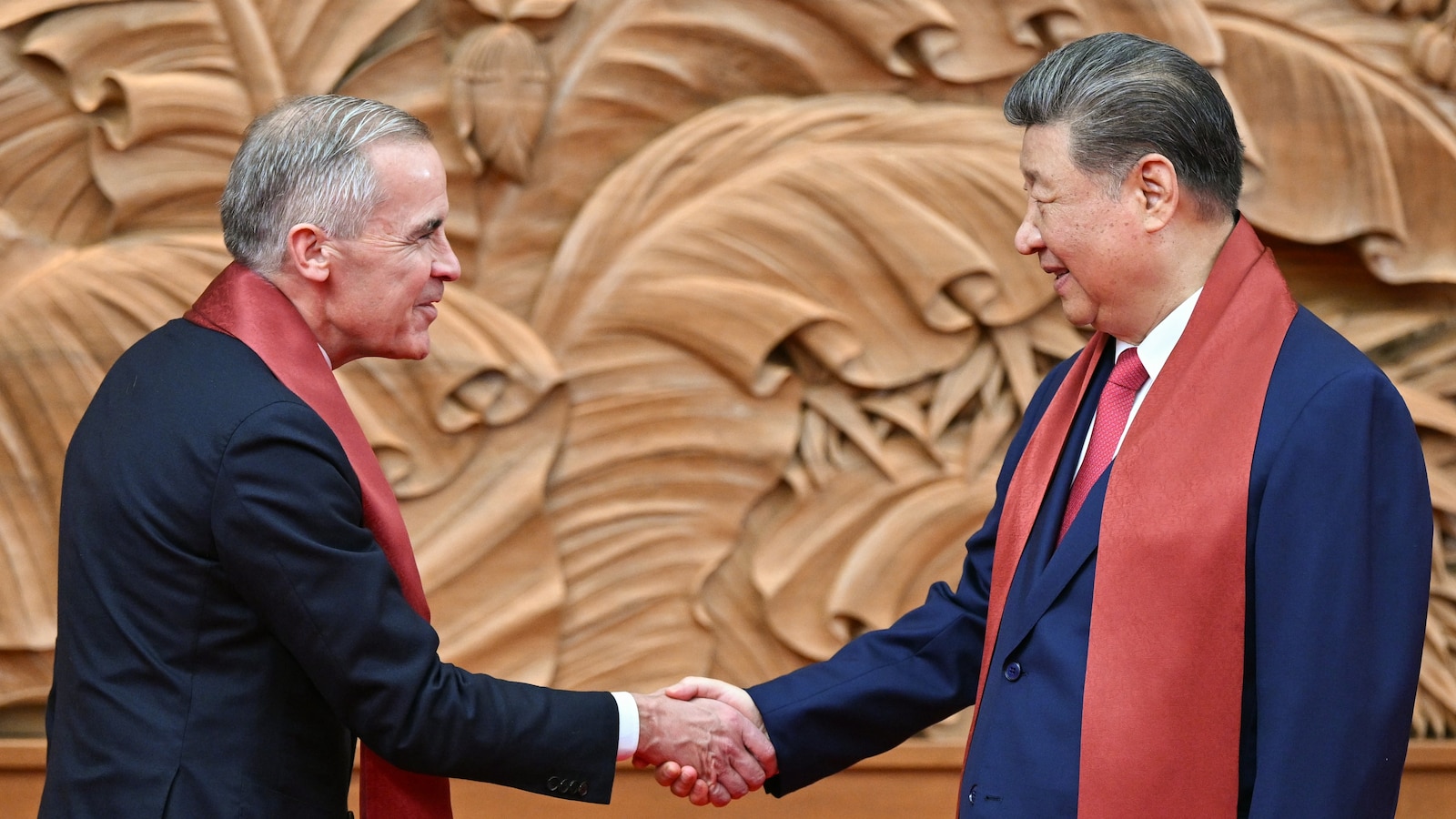
Chen's remarks came days after Carney met Xi in Shenzhen and agreed to additional tariff reductions, as Canada seeks to diversify its trade during U.S. President Donald Trump's trade war. Carney said Canada could turn to Chinese automakers if negotiations with Washington fail to preserve a viable Canadian auto industry. Trump has threatened 50% tariffs on Canadian vehicles and auto parts beginning Jan. 1. Chen warned that Chinese electric vehicles could threaten Canadian manufacturers and pose surveillance risks because of their connected technology, even if they are manufactured in Canada. Carney has argued that Canada's trade relationship with China differs from Washington's more complicated ties with Beijing, noting that Canada mainly exports agricultural products, energy and other commodities rather than sensitive technologies such as advanced semiconductors.
Chen said Taiwan had sharply reduced its economic dependence on China after Beijing used trade restrictions to exert political pressure. "They are very good at weaponizing interdependence," he said. "They are very good at leveraging our dependence to reach political goals." According to Chen, Taiwan cut the share of its outbound investment going to China from more than 80% in 2010 to 3.8% last year. Taiwanese government figures show its exports to China and Hong Kong fell from nearly 44% of total exports in 2020 to about 27% last year.
Chen also accused Beijing of exploiting a widely circulated photograph from this week's Shenzhen summit, which showed Xi seated prominently between Trump and Russian President Vladimir Putin. "The main idea is to prove not only to his domestic audience that he is the world leader," Chen said, adding, "They are so good at propaganda." He described the summit as "more symbolic than substantial."
Chen said China was intensifying military operations around Taiwan despite the potentially enormous costs of an invasion. He warned that Chinese vessels could be rehearsing for a maritime quarantine of the self-governing island.
Despite his concerns about Beijing, Chen praised Carney's international leadership and welcomed his commitment to sign a long-delayed trade cooperation arrangement with Taiwan. "We have a high respect of Prime Minister Carney's vision," he said. "And we want to be part of this vision."