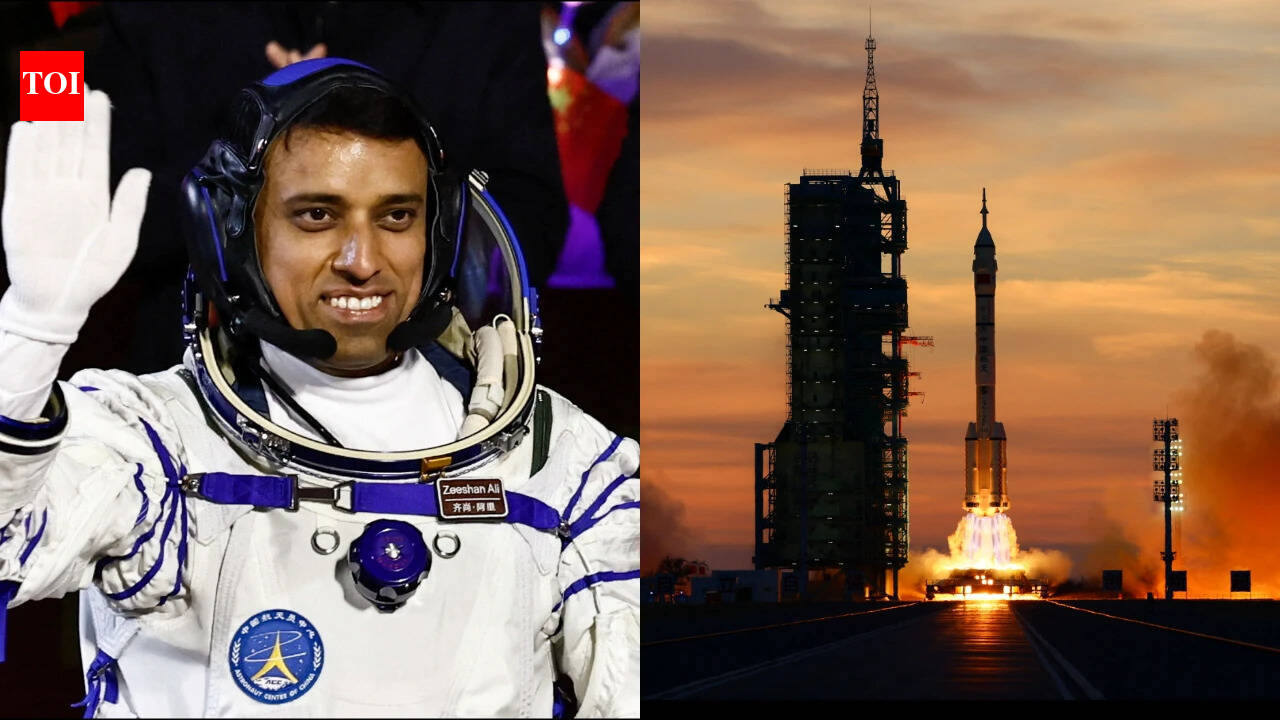
China on Wednesday launched its Shenzhou-24 crewed spacecraft carrying three astronauts, including Pakistan's Muhammad Zeeshan Ali, who became the first foreign national to take part in China's crewed space programme. The spacecraft lifted off at 8:18 a.m. Beijing time (00:18 GMT) aboard a Long March-2F rocket from the Jiuquan Satellite Launch Centre in northwest China, according to reports, and the China Manned Space Agency (CMSA) declared the launch a complete success.
About 10 minutes after liftoff, the spacecraft separated from the rocket and entered its designated orbit, the CMSA said, adding that the astronauts were in good condition. The craft then completed its rendezvous and docking with the Tiangong space station, which the CMSA confirmed, about three hours after launch. Reports describe the docking as the first time a foreign astronaut has joined a crewed mission to the station.
The crew consists of mission commander and spacecraft pilot Tang Hongbo, flight engineer Wu Yi and Ali, a 40-year-old Pakistani Air Force pilot who is serving as a payload specialist. Ali will carry out routine crew activities and joint China-Pakistan experiments in biotechnology and materials, and he is also scheduled to run an in-orbit experiment involving photosynthetic cyanobacteria. Reports differ on the length of his stay: The Hindu and Business Standard-linked reports describe about a week, while India Today reports five to 10 days. Ali is scheduled to return to Earth aboard Shenzhou-23 with two members of the existing crew, Zhang Zhiyuan and Li Jiaying.
The mission also includes an unusual crew rotation. Zhu Yangzhu, who is already aboard Tiangong, will remain in orbit for a long-duration stay study. Times of India and India Today describe this as a year-long mission, which would make him China's first astronaut to undertake one. Rediff reports that he will stay for another six months. Tang and Wu are expected to remain aboard for about six months. The CMSA said more than 90 scientific experiments and technology tests are planned, covering space life sciences, materials science, microgravity physics, space medicine and new space technologies.
The flight stems from an agreement China and Pakistan signed in February 2025 covering astronaut selection, training and participation in Chinese space station missions. Two Pakistani candidates were shortlisted and trained in China, and Ali was selected for the flight, with the other candidate retained as a backup. To prepare, Ali trained for seven months in Beijing, studying Chinese-language classes, Chinese songs and poetry, calligraphy and table tennis, according to Economic Times.
Chinese President Xi Jinping and Pakistani President Asif Ali Zardari exchanged congratulations on the joint mission, which Rediff reports is taking place during the 75th anniversary of China-Pakistan diplomatic ties. In Pakistan, Prime Minister Shehbaz Sharif described the mission as a source of national pride and wrote on X that it was 'not just one astronaut's journey, but the journey of 240 million Pakistanis.'
China built Tiangong after it was reportedly excluded from the International Space Station (ISS) over concerns about the involvement of its military, the People's Liberation Army, in its space programme. China is currently the only country operating its own space station, which became operational in 2022. Tiangong is smaller than the ISS, where astronauts from several countries have conducted more than 3,000 experiments since 1998. NASA plans to retire the ISS in early 2031, according to reports. For Pakistan, Ali's flight marks its entry into human spaceflight, and for China, it is the first operational demonstration of its plan to open Tiangong to international participation.