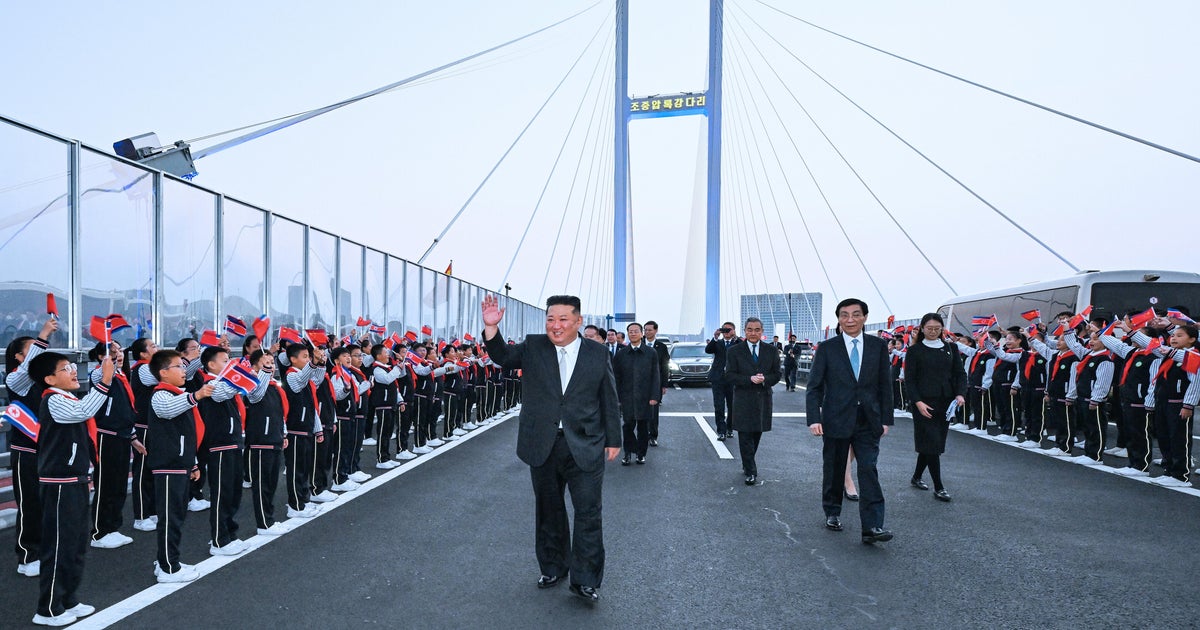
North Korean leader Kim Jong Un traveled to China on Saturday, crossing a newly inaugurated bridge that connects the two countries for the first time in over a decade. The visit marked his first trip to China in a year and comes as the neighboring nations move to strengthen economic and diplomatic cooperation.
Kim arrived in the Chinese border city of Dandong after crossing the New Yalu River Bridge, which officially opened earlier this month following more than a decade of construction delays, according to South Korea's Unification Ministry and China's state-run Xinhua News Agency. During his time in Dandong, Kim met with Wang Huning, a member of the Standing Committee of China's Communist Party—one of the country's most senior leadership positions.
The meetings emphasized bilateral cooperation. Kim visited a memorial dedicated to China's role in supporting North Korea during the 1950-53 Korean War, where he stated that the Democratic People's Republic of Korea would "firmly carry forward the invincible DPRK-China friendship forged at the cost of blood all the time," according to North Korea's official Korean Central News Agency. Wang conveyed greetings from Chinese President Xi Jinping and described Kim's visit to the memorial as "of great significance" in maintaining the countries' historical bond. The two also toured an automobile factory in Dandong before Wang accompanied Kim back to the bridge for his return home.
The bridge opening and Kim's visit signal a deliberate effort to reinvigorate trade and economic ties between the nations. Analysts noted that the three-kilometer New Yalu River Bridge resolves what had become a major logistics bottleneck, enabling the transport of heavy equipment, raw materials, and energy products that North Korea requires for development. The bridge is expected to accommodate two-way traffic around the clock, including container shipments and heavy cargo trucks.
The timing of Kim's visit carries symbolic weight. The trip comes days before the October 25 anniversary of China's first major military victory in the Korean War, when Chinese troops crossed the Yalu River into North Korea in 1950. This appears designed to underscore the strength of bilateral ties ahead of that commemorative date.
Kim's focus on China represents a recalibration of North Korea's foreign policy priorities. In recent years, he had prioritized ties with Russia, sending thousands of troops and conventional weapons to support President Vladimir Putin's invasion of Ukraine. However, North Korea and China have pursued closer engagement in the past year, with Xi Jinping making a state visit to Pyongyang in June and Kim previously visiting Beijing in September 2025 to attend military parade celebrations and meet with Xi.
The visit occurs as U.S. President Donald Trump seeks to revive diplomatic engagement with North Korea before year's end, though U.S. and South Korean officials have indicated that prospects for a Kim-Trump meeting before the end of 2026 appear limited.